
Architecture Tour
Stretch your legs or take a leisurely drive around Grinnell and admire the incredible architectural heritage Grinnell has to offer. Our tour is designed to offer a sample of a variety of architectural types. Emphasis has been placed on building which were originally designed to serve one purpose and have been successfully altered to serve another. All of the stops on this tour are to be viewed from outside but a few have limited open hours for interior visits. This route also takes you through the beautiful historical northwest section of Grinnell where many residential homes from the early 1900s still stand.
Route Scout: Dorrie Lalonde, Grinnell Historical Museum. Distance 1.9 miles.
1. Merchants National Bank
833 4th Avenue
Completed in 1914, this bank was Louis Sullivan’s third major “Jewel Box: bank created in the final decade of his life. The building, nearly cubical, suggests security and stability needed in a bank, but the stonework and terracotta ornamentation modify the austerity of the structure. The center of visual interest is circular stained glass window over the entrance. The Interior decoration continues the themes of the building’s exterior. Additional information is available in the bank, which is now occupied by the Grinnell Chamber of Commerce and open Monday-Friday 8:30 AM - 4:30 PM. Call ahead at 641-236-6555 for weekend or after hours appointments.
2. Old Glove Factory
The Morrison, McIntosh & Company’s business was established shortly after F.W. Morrison arrived in Grinnell and developed a process which produced gloves from goatskin and other leathers. The glove factory was constructed following the destruction of the earlier Morrison plant in the fire of June 1889. The building was three stories high with ceilings of proper height to ensure ventilation and light. Grinnell College owns the building and recent renovations were planned by Herbert Lewis Kruse Blunck Architecture, Des Moines. The design features a core-entry courtyard and renovated foyer with offices in existing buildings on both sides. The Old Glove Factory is open to the public from 8 AM - 5 PM Monday through Friday.
3. Rock Island (Union) Station
1014 3rd Avenue
The Rock Island Station was completed in 1893 at a cost of $5,000. The stone and red-brick structure was built in a modified Queen Anne style with a tower 12 feet in diameter at the southeast end. The need for a station became evident in the lat 1880s when the Mississippi and Missouri railroads intersected at Grinnell. The 1893 building contained two waiting rooms, a baggage room, lunch counter, and offices. Prior to WWI, a scheduled stop at Grinnell gave passengers an opportunity to dine at the Monroe Hotel north of the station. Passenger service to Grinnell continued until May 1970, and the building lay empty until it was purchased and restored in 1993. The building opened as a restaurant in 1995, housing the Peppertree at the Depot Crossing restaurant until June 2020 and is currently home to El Cascabel Mexican Restaurant.
4. Grinnell House
Grinnell House was built in 1917 to replace the Little House, the former college president’s residence, and served as the president’s home until 1961. Designed by Brainerd (Grinnell College class of 1883) and Leeds, Boston, it was patterned after the president’s home at Harvard university. It is designed in Georgian or Federal style with symmetrical or “Palladian” elements on the exterior: the doorway in the middle of the facade with 2 windows on each side and large bays at each end of the first floor. It is currently used as a social center and college guest house. Grinnell House is not open to the public.
5. Goodnow Hall
Completed in 1885, Goodnow Hall was designed in Romanesque Revival style (Stephen Earle, Worcester MA, architect) with walls of Sioux Falls quartzite and Missouri sandstone trim and window accents. The heavy walled tower at the northwest corner was intended to support and house the college’s telescope. It is the only remaining structure of the first four buildings constructed after the 1882 tornado and was originally intended to serve as the college’s Library. Goodnow was extensively renovated in 1995 to house the Anthropology Department which it still houses today along with Global Development Studies. Efforts were made to retain as much of the west one-third of the building as originally constructed, with woodwork, stained glass, windows, and staircase refinished or replicated. Goodnow Hall is open to the public from 8 AM - 5 PM Monday through Friday.
6. B.J. Ricker House
An excellent example of the Prairie School of Architecture, Ricker House was designed by Walter Burley Griffin of Chicago, an associate of both Louis Sullivan and Frank Lloyd Wright and designer of the Clark Fountain, formerly in Central Park. Griffin’s wife Marion Mahony, created the tile work in the home. The house was built in 1911 for Benjamin Ricker and his wife, Mabel; at the time, Ricker was a partner in the Morrison-Ricker Manufacturing Company, which made gloves. The exterior has a strong horizontal emphasis, accented by vertical detailing on the second story. Interior highlights include oak woodwork, cove lighting, recessed bookcases, and sleeping porches. Marion Mahony Griffin’s terra cotta tilework appears on the fireplace in the study and living room as well as the exterior of the house. This house was previously owned by Grinnell College and is now a private residence.
7. McMurray House - Grinnell Historical Museum
The Grinnell Historical Museum is located in the home built in 1895-96 for local retailer J.H. McMurray and his wife, Floy. The house and the one to the north were both constructed from plans developed by George F. Barber, who marketed similar designs nation-wide. With it’s elaborate woodwork and amenities such as central heating, electricity, and running water, the home justified its original cost of $8,000. The carriage house in the rear (which houses several Spalding and Laros buggies) was constructed in 1992 from the original plans, and both it and the McMurray home have been painted in the original colors of green and black. The McMurray House is open by appointment only, call 641-236-7827.
8. E.H. Spaulding House
1103 Main Street
This Prairie-Style house was constructed between 1905 and 1907 at a cost of $15,000 (Hawlett and Rawson, Des Moines, architects). The family owned the Spaulding Manufacturing Company, maker of buggies and later of automobiles. The building materials - limestone and buff-colored bricks - were unique at the time in residential Grinnell. Originally the East side of the house had a semi-circular brick tile floor. Subsequently enclosed it now serves as the home’s main entrance. For a time in the 1930s, the house was the Wayside Inn, operated by the widow of one of the Spaulding Company heirs. It was then the Spaulding Inn Bed & Breakfast for a number of years before becoming a private residence.
9. Strand Theatre
931 Main Street
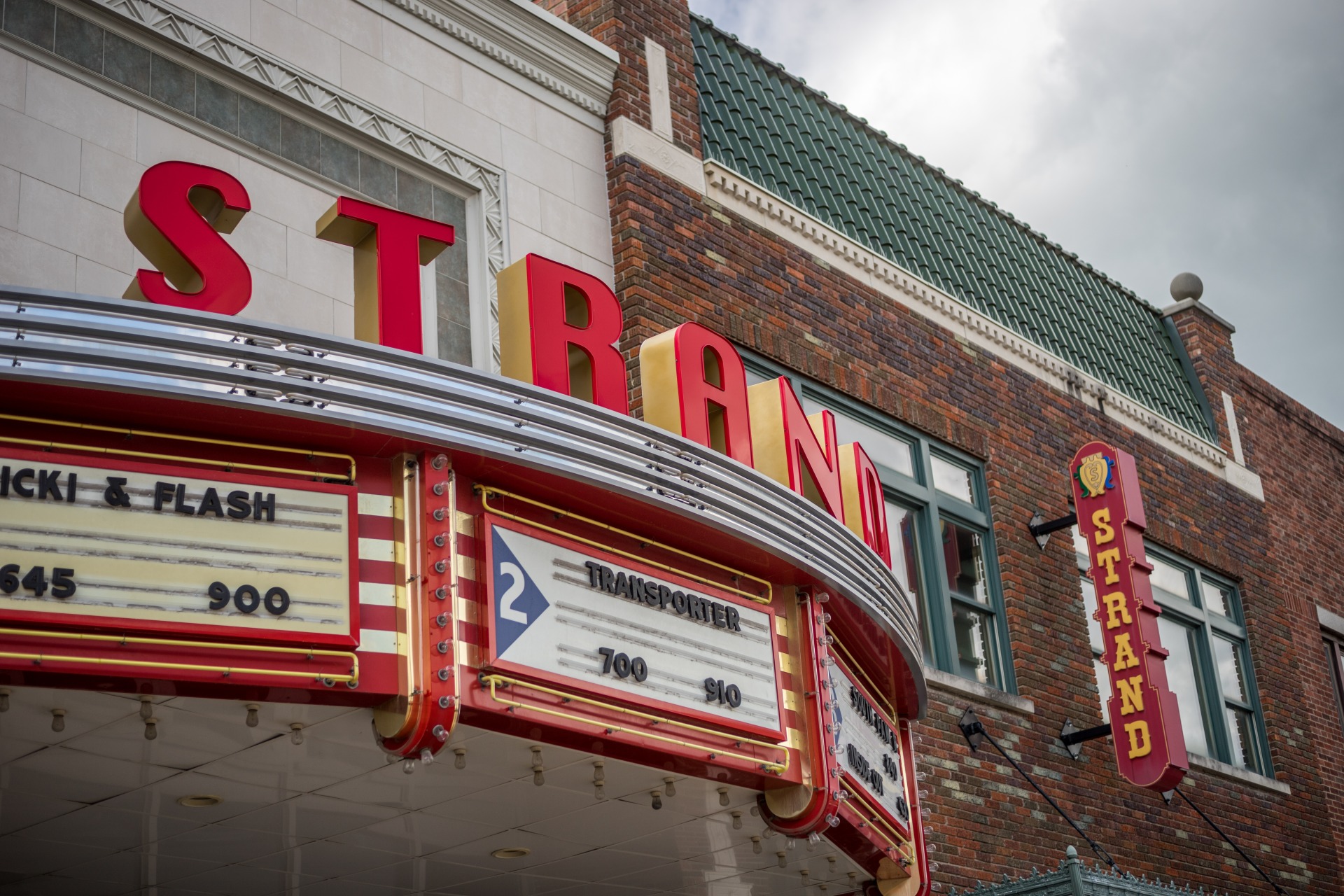
Constructed in 1916, the Strand Theatre was purpose-built for motion pictures. It included a lobby, foyer, and auditorium seating for 588 patrons. The exterior was two-story, brick with canopy and a mansard-type tiled roof. The Original canopy was removed in the 20s or 40s and the exterior sheathed with metal. In 2003, the sheathing was removed to reveal the original decorative elements and the building renovated, incorporating a store-front to the south to create a triplex theatre, which opened in 2004. A small museum of Strand artifacts is located in the northeast corner which can be visited during operating hours. Visit the Fridley Theatres website to see a list of showtimes for open hours.
More News + Announcements
Our Partners